Celebrating spring and poetry

Does spring inspire you to write poetry?  April is National Poetry Month and we are finally seeing the signs of spring here in Iowa. In honor of both, here’s a poem I wrote. An homage to William Carlos Williams.

Prairie, GranddaughtersThe Brown Prairie

so much depends
upon

a brown spring
prairie

beaten down by
winter

through a child’s
eyes

* * *

I wrote this poem in response to the prompt “so much depends upon.”  If you’d like to respond, in poem form or otherwise, I’d love to know what images that prompt – or the green grass and flowers of spring – trigger for you.

Gratitude in a drought?

Hot, dry weather yields brilliant fall color – 2012

Are all these sunny, dry days good for us? Only in Iowa would someone even ask that question! I spent last week in California where no one ever questions “yet another day in paradise.” But here in Iowa, too much of a good thing can be a bad thing.

As the sunny, dry days stretch on, I look at my flower gardens, which I don’t water, and wonder how many of the plants I’ll lose by next spring. I look at my prairie, which history says can stand the swings of nature, and notice that the grasses thrived in the dry heat while the flowers were much less lush and brilliant. And all of the prairie plants were shorter.

The farm fields suffered painfully in the drought. I hated even to look as I drove by many fields of corn. The leaves were curled up and pointed to the sky, as though pleading for rain. When none came, eventually, the stalks wilted, turned brown and crumpled. Yields are way down and we’ll all feel the farmer’s pain at the grocery store in coming months.

At lunch today, a friend commented, “This area wasn’t made for perfect weather all the time.” He’s right. Iowa thrives with the change of season. We thrive when we have sun mixed with regular rains, hot days followed by cold days. We thrive when it all evens out.  This year hasn’t been like that. I joked when we were getting 70 & 80 degree days in March that we were going to have the longest summer on record. I didn’t know how right I’d be. I didn’t know it would be a California summer.

Looking past concerns of drought, I have to say a California summer in Iowa is beautiful – the endless perfect days, the ash trees turning gold. I’ve determined to be grateful for the beautiful weather, to marvel in the brilliant colors, to be outside as much as I can be. And to try not to worry that there’s no rain in the forecast for another 3-4 weeks. If then.

I will remind myself that in all things I can give thanks.

In need of peace

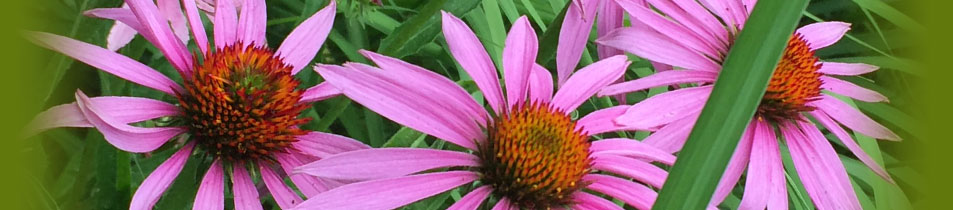
Purple Coneflowers

Deadlines and ‘shoulds’ were getting to me yesterday, so I headed to the prairie to take a break, hopefully to find a little peace. The prairie welcomed me with bright colors and gentle breezes. A half hour in the prairie and I returned to my desk refreshed. 

Join me for a few minutes in the prairie where I’m going to let nature speak for herself in these pictures.

Wild Bergamot beginning to bloom.


Rattlesnake Master


Hoary Vervain and Black-eyed Susans>


Purple and Greyheaded Coneflowers


What’s new in the prairie?

Pale Purple Coneflower

My normal tendency is to worry. But the prairie has taught me at least two things: 1) the prairie can take care of itself and 2) my worrying about it accomplishes nothing. So I approached the prescribed burn we conducted in March with optimism. Simply the next step in prairie life.

I’m pleased to report that the prairie is thick with growth since the burn. Grasses and forbs are waist high. Some plants are even taller. Many of my old favorites are back along with some that are new. Dots of yellow, blue and pink blooms are a small taste of the technicolor blast to come.

Common Spiderwort

The first blooms of the spring were Spiderworts. The name isn’t appealing, but the multitude of bright blue blossoms (picture shows much paler than they really are) that grace the end of each stalk certainly are.  A friend and I went to the Neal Smith Wildlife Refuge recently. It’s always fun to see what plants they have blooming compared to what’s in my prairie. I saw  spiderworts  sprinkled throughout the prairie. I only have this one cluster of plants and hope to encourage more in future years. That blue over a wide space is lovely.

New! I spotted my first Pale Purple Coneflowers this spring. Unlike the Purple Coneflower, the Pale Purple variety has delicate, long slender leaves. The petals are thinner and paler pink (not surprising given the name). Apparently this variety also blooms earlier in the spring since I don’t have any Purple Coneflowers blooming in the prairie yet.

Showy Tick Trefoil

I finally took my Tallgrass Prairie Wildflower book to the prairie to identify this flower that perplexed me last year. I am almost certain it’s a Showy Tick Trefoil. What causes me to stumble is that the book says it blooms in mid-late summer. And here it is one of the earliest blooms. So I could be wrong. If anyone has another idea, please let me know.

There is a redbud tree in the middle of the prairie and I wondered how it would survive the burn. It suffered a setback but I’m pleased it is still alive. For a while, I wasn’t sure. The few blossoms came  weeks later than other nearby redbuds. Leaves came from near the base of the tree but not the tips of the branches. I took the loppers and did a hard prune yesterday. It looks better than it did, but has quite a bit of coming back to do.

Fortunately, the bluebirds still find the tree a favorable spot from which to eye the birdhouse we build for them. We had one hatch already and I’m keeping my fingers crossed for another.

Do any of you readers enjoy the prairie as much as I do? I’d love to hear where you visit the prairie and what you’re seeing.

Cheering first steps!

My granddaughter Eliza took her first solo steps on Sunday. And she did it right in front of me. How lucky is that? Her mom and dad and sister saw it too. We applauded. We cheered.

She fell down. But right away, she planted her hands on the floor, stuck her butt in the air, and stood up again. She toddled three steps into her daddy’s arms. More applause! The delight on her face made our hearts sing.

My other granddaughter struck off on her own that same day. Each time they visit our acreage, we walk to the prairie to see what’s new. On every previous trip, Hannah has needed my encouragement to venture into the prairie jungle. I always encouraged her to step in boldly, but I always had to point out openings she could get through and push plants out of the way. 

As we walked to the prairie this time, I asked, “Do you think we can find a path?” She walked right up to the prairie and said, “There’s one, Grandma!” And she didn’t wait. She pushed through, clearing the path herself, stepping boldly around, over or on anything in her way. I cheered. How wonderful to see the new confidence that has grown in just a few months.

After they left, I thought a lot about ‘firsts’ and why they’re so important to us. We cheer the big firsts – the first man to walk on the moon, the first black child to attend a white school, the first woman to become the CEO, the first same-sex couple to marry. We also celebrate individual firsts even though those firsts have been accomplished by millions before us – the first step, the first time we drive a car, the first novel an author publishes.

Each first represents breaking a barrier. Whether the barrier broken is individual, technological or societal. In doing something once, we learn. We gain confidence. We have faced the challenge and overcome it. We come to believe we can do it again. And so we celebrate.

Eliza took her first steps. Now she knows what we all learn from doing that first hard thing. By trying and trying she learns. By trying and trying she can succeed. There will be no stopping her now!

First blooms in the prairie

All signs of the prescribed burn we did on the prairie a month ago are gone. With each rain, each wind, each day that passes, the burn is less visible. In fact, only a few blackened stalks remain. New green growth rules. But each plant is discrete. This early in the season, patches of the ground are clear.

As I walk the prairie now, it’s encouraging to see now-familiar plants emerging–coneflowers, asters, cup plant, blackeyed Susans. And my favorite from last year–rattlesnake master–is there, too.

But the prairie is full of surprises. The first blooms of spring aren’t any of the plants I recognize. Instead, the first bloom is an entirely new plant to me.  Golden Alexanders.

When I first saw them, I feared we had an infestation of wild parsnip–a plant that is noxious and actually dangerous if you get the sap on your skin. But I took my trusty prairie wildflower book to the prairie and made a positive identification. Leaves and flower formations all confirm these plants as Golden Alexanders, a member of the parsley family.

My book notes that early pioneers thought the plant would cure syphilis.  One has to wonder how they may have come to this conclusion?!?

Another new resident in the prairie this year is a bluebird. We put a bluebird house at the edge of the prairie last year, but too late to attract anyone interested in nesting.  This year, a bluebird moved in right away. When I walked by the birdhouse, thinking I’d take a peek inside to see if anyone had taken up residence, the mama came flying out. I quickly walked away. Now that I know she’s nesting, I’ll give her a wider berth.

The prairie is an endless source of learning and surprise. I’m glad it’s spring in the prairie yet again.

Burn, prairie, burn!


My experience with fire is limited. Contained blazes in fireplaces and smaller campfires are comforting, welcoming, inviting on cold nights. I’m rather fond of those.

Other fires–forest fires or grass fires to clear out roadside ditches? I’ve never experienced one, and I’m just fine with that.

Yet here I was this past week chomping at the bit to start a fire, because I have a prairie. Fires are prescribed on prairies – generally every three or four years. Part of the natural cycle of prairie life, cleaning off plant waste, keeping brush and volunteer trees under control.

With the open, dry winter we’ve had, any burn could be risky. My complete lack of experience makes it more so. I looked to my more experienced husband. He kept telling me it would only take 15 minutes. I know my prairie patch isn’t all that big, but I was skeptical.

We went to the prairie, well prepared, waiting until dusk when the wind died down. We had newspapers and a lighter to start the fire and buckets of water and rakes to stop it if we had to. I called the county emergency services to alert them to our plan.

We tucked lit newspapers in the up-wind side of the prairie. In seconds, the dried plant residue kindled and flames grew. In less than a minute the fire was so hot I retreated 20-30 feet. The fire swept along, fueled by the brush, pushed by the breeze.

As a rabbit ran ahead of the fire, I couldn’t help but think of a wide open range fire with buffalo, antelope and other wildlife stampeding to escape. I wondered at my own ability to escape such a blaze. A creek, for sure. But could I hide under an overturned wheelbarrow or any other inflammable structure? Someplace. Anyplace, to be safe. I doubt I could have outrun it. Scary thoughts, indeed.

Even in my small prairie, the fire was impressive. It was exciting. I called emergency services to tell them our fire was out. It was over in 19 minutes.

March in the prairie

Sometimes it takes a 3-year-old to make me see what’s right in front of me. My Granddaughter Hannah and I took a walk out to the prairie this weekend. To me, the prairie looks brown. Flattened by wind and snow. There’s not much going on.

Hannah saw something completely different. She waded right in. “What’s that?” she asked. “That’s Indian grass,” I explained. She took a frond and waved it over her head. “What’s that?”  “That’s a dried cone flower. Want to pick a bouquet?” “No. What’s that?”  “That’s an aster; they’re purple when they bloom.”

The fallen plants I could ignore as I stepped over them with ease were waist high to her. “Just step on it!” I urged. “I step on it,” she agreed, marching on.

We spotted a butterfly, small and brown/gold. A little early in the season, I think. But there it was, flitting about too quickly to be caught.

We flushed a rabbit. It heard us coming and shot out of the undergrowth like it was fired from a cannon. Hannah scrambled after it, unable to catch up, but passionate to try.

Every bit of my dried out, used up, blown down, patch of prairie was something for her to enjoy. I’ve been looking past the brown, eager for the new green shoots of spring and the brilliant colors of summer. It took a 3-year-old to show me there’s good reason to visit the prairie and enjoy all that’s there right now.

Showy fall flowers

Crossword puzzle clue: Showy fall flower

Answer: Aster

Did you think asters?  Since a crossword puzzle is part of my everyday routine, ‘aster’ and ‘showy fall flower,’ are always linked in my mind. Asters are very pretty, I admit, with their yellow centers and purple petals.  But when I walk outside at this time of year, I wonder why other flowers do not vie for showy fall flower honors?

Why do the puzzle writers not think Tall Golden Rod? The fronts of golden rod are neon yellow turning to red gold and rust at this time of year.

Why don’t they consider Maximilian Sunflower? Growing taller and more gangly all season, the Maximilian sunflowers now reach eight or nine feet and sport bright yellow flowers all along the stalks. Stunning.

Equally showy are the purple sweeps of hosta blooms south of my house.  A rather plain dark green hosta throughout the year, this one variety has two things to commend it. It multiplies like crazy, filling in space wherever it’s planted. And when it blooms, it puts up countless stems of purple blooms.

I get it. Asters are showy fall flowers, but perhaps more important, their name includes the letters so helpful to forming other words. I just think puzzle writers and solvers would benefit from enjoying the many flowers that brighten fall gardens.

Taste & smell the prairie

“Taste this,” I say, pulling leaves off a small prairie plant and handing them to friends who tour my prairie.

“Taste it?” they ask, skeptical.

I nod.

With some hesitation, they do.

“It’s licorice!” they exclaim.

Watching the recognition dawn on their faces is such fun. The licorice taste of a Anise Hyssop leaf surprises everyone.

The prairie surprised me this fall when it revealed a new plant. Boneset is in full bloom – a drift of fresh white flowers standing amidst the dried brown seedheads of coneflowers and black-eyed Susans. What makes this surprising is the scent.  Just like Lily of the Valley.

Prairie flowers don’t have much scent – at least in my experience. So it’s a treat to not only find one that does, but one that has such a pleasant, old-time fragrance.

On top of excellent taste and a romantic scent, the prairie is covered with gold – or at least it appears so with the grasses waving their green-gold and red-gold plumes in the afternoon breeze.

It may look as though the prairie is closing down for the season, but far from it.  Licorice. Lily of the Valley. Gold. When you least expect it, the prairie comes through – full of surprises.